Journey to the Source of Color: Treasures of MarrakechSouk des Teinturiers – Fabrics, Yarns, and Leather

Have you ever experienced the scent of a color?
November 2024
Marrakech is a city where colors are more than just visual—they tell stories, carry traditions, and leave lasting impressions. Among its many wonders, the Souk des Teinturiers (Dyers’ Market) stands out as a place where fabric, yarn, and leather are transformed through centuries-old dyeing techniques.
The air is thick with the scent of pigments and tanning vats, while vibrant skeins of wool hang overhead, drying under the Moroccan sun. Rich reds, deep indigos, and golden yellows fill the narrow alleyways, each shade holding echoes of the past.
Once upon a time, these colors were extracted from nature—poppy petals, saffron threads, and indigo plants—but today, synthetic dyes have largely replaced them.
Visiting Marrakesh had been planned for a long time. I made every effort to prepare—researching what to look for, and what to expect once there.
What I didn’t anticipate, however, is how Marrakesh would intertwine color and scent in my memory. Whenever I think of Marrakesh, I can almost smell its colors. And when I think of color, I can sense its fragrance. I had romanticised image of Marrakech as a city of natural dyes and artisanal traditions can sometimes clash with reality. While the markets (souks) proudly display vibrant powders of blues, reds, and yellows, many of these so-called "natural" colorants are actually synthetic. It’s a bit sad, especially for those who appreciate authentic craftsmanship. But, for those not seeking nature origins, this is absolutely fantastic treasure place to be.
One of my main goals was to visit the famous Souk des Teinturiers in the Medina.
To my surprise, it wasn’t concentrated in one single spot as I had imagined, but rather spread across various souks in the Medina. Eventually, though, we found it—and it was well worth the search.

Picture above: Souk des Teintures. Dyers Souk, Medina of Marraketch
Not far away from Jardin Secret.
Walking in Medina feels like stepping into a labyrinth of merchants and artisans, where narrow streets are alive with the mingling aromas of exotic spices and the scents of materials being worked on at that very moment.
What actually Souk is? The term souk originates from Arabic and refers to the bustling marketplaces commonly found in the Middle East and North Africa.

The medina's different quarters are dedicated to various trades, offering visitors a glimpse into the rich diversity of Moroccan craftsmanship. Here, skilled artisans can be seen meticulously creating pottery, metalwork, leather goods, and textiles. Every twist and turn may unveil a new handcrafted gem, from vibrant Berber rugs to intricate silver teapots.
A closer look
But back to the colors—what you’ll find here are the famous dyers' souks, where vibrant wool carpets and Sahara scarves come to life in a riot of hues.
As you wander through the market, merchants call out from every direction, urging you to step inside, to look, to touch. And then, almost by accident, you find yourself in a small dyeing workshop—tucked away in a corner, yet impossible to miss.
Striking strands of wool, dripping with fresh color, hang in the open air, inviting you to explore. The sight is mesmerising, but entry comes at a price—unless you’re willing to leave a few coins behind, the welcome quickly fades. With a small tip, however, the hardworking artisans gladly demonstrate their craft, even letting you take photos as they dip and swirl fabrics into vats of color.

With a smile, one dyer proudly explains his process. "All natural!" he assures me.
But the truth lingers in the air. The scents don’t match the promise. Neither does the look of the dyes. Deep down, I knew they weren’t natural. And yet, I wanted to believe. I wanted to find the true, raw source of color—the kind born from earth and plant, not from chemicals and convenience.
Nevertheless, all in all, its still great experiences see someone doing that work on the street. See the supply chain, from fiber, via dying and delivering to carpet weavers and see product on the street selling.

The colors of Marrakech are impossible to ignore—bold, vibrant, and utterly immersive. They don’t just surround you; they pull you in, leaving a lasting impression of the Medina’s energy.
Here, color isn’t just seen—it’s felt, even smelled. Whether you seek it or not, sooner or later, you’re completely absorbed by it. The city itself feels like an extension of this kaleidoscope, a place where every shade tells a story.
Tourist attraction or not, it’s undeniably inspiring. The colors lift your mood, filling you with the essence of Marrakech—alive, rich, and unforgettable.


Since the very first day i have tried to discover what colorants do they sell. What is a name, origin of those colors. And i must say, my yes were shining seeing mountains of pigments, exposed on the market street in the herbal stores. Like diamonds to me.
The very first merchant, herbalist, invited us seeing our interest in pigment, for a tea, because this is how they do business here.

You do not need even to start asking for pigments, they will tell you that, red is from poppy, blue is Nila, black is from black stone and yellow from saffron.
I so wanted to believe that at least some of the colors were natural. I asked countless questions, and each time, they assured me—"Of course, all-natural!" Hehe.
After buying a few, I decided to dig deeper into their story. And, well… in the past, yes, those were the sources. But today? Let’s just say tradition and reality don’t always go hand in hand.

The pigments spill out among perfumed stones, dried flowers, fragrant herbs, and an array of Moroccan oils. Yet, despite their beauty, none of the colors are truly natural.
But the stories behind them? Those are real. And that alone made it worthwhile—a starting point for deeper discovery.

So, the famous Moroccan blue—known as Nila—has a story of its own. Today, much of what is sold as Nila is synthetic, but traditionally, the true Nila was none other than indigo.
This deep blue powder has long been woven into Moroccan culture, especially among the Berber men and women of the mountain regions. For centuries, women in the Sahara used Nila to shield their skin from the sun and enhance its natural glow. One of their most cherished beauty rituals involved soaking long scarves in Nila-infused water and wrapping them around their bodies. Some would leave this treatment on for days, allowing the pigment to gently brighten and rejuvenate their skin.

For Berber men, Nila served a different purpose—protection from the elements and insects. They would wrap their faces and bodies in dyed cloth, the blue pigment rubbing off onto their skin, leaving them with a distinct blue hue. And from this tradition, the legendary "Blue Men of the Desert" were born.
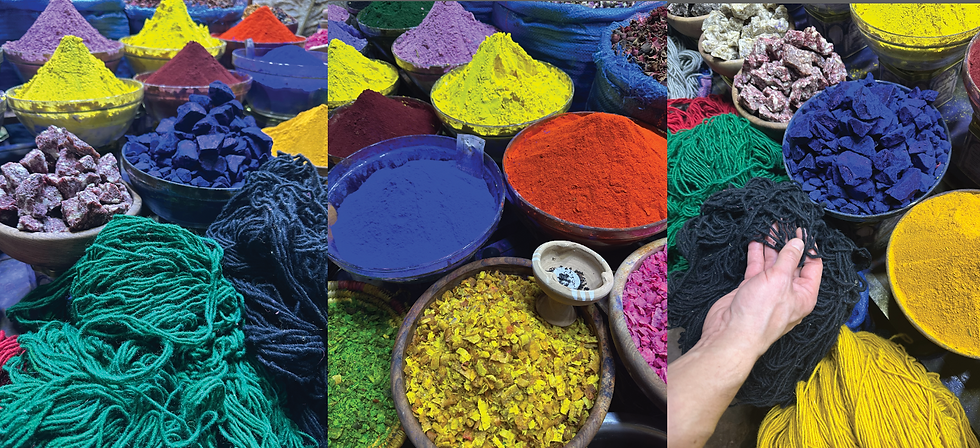
In the past, natural dyes were deeply woven into Moroccan traditions—vibrant red from poppy flower petals, the rich yellow-red of saffron, and the golden hues of turmeric all played a role in coloring fabrics and textiles. Sadly, the colors in the pictures above do not originate from these natural sources.
Last but not least, my curiosity led me to the leather tanners of Marrakech—a craft as fascinating as it is historic.
And yes, the stories about the smell? Absolutely true. A scarf over the face helps—a lot—especially if you tuck a sprig of mint beneath it. I had hoped to learn more about the tanneries firsthand, but aside from watching the process from above, the only information I got was the usual assurance: "All natural!" Hehe… of course!


This was truly one of the best color quests I’ve ever taken. Even though I didn’t find all the answers, the journey only fueled my curiosity, pushing me to seek more. A beautiful country—where colors have a scent, and their memory lingers with you long after you leave.


Comments