In search of the origin of color_Roussillon Ocher Museum

Sep 5, 2023
3 min read
Updated: Sep 6, 2023
Ôkhra - Écomusée De L'ocre Roussillon
July 2022

Within 15 min drive from Apt toward the forest we find Ocher Conservatory in Roussillon.
It is definitly place worh visiting if you are in the Luberon area.

Luberon region map with areas of gold dust.
The entrance to place is very colorful and invative.
The ocher eco-museum occupies a former ocher transformation site, the Camille Mathieu factory. Abandoned in the 1950s, it has been rehabilitated to become a place of history and discovery. It produced 1000 ton of ocher between 1921-1963, from 1994 opened for visitors as museum.


Entrance to EcoMuseum ôkhra
The museum offers guided tours, but we are ready to explore place in our own tempo. It is nearly evening, but temperatures are still so high, that we try to move from shadow to shadow. We start with some ocher background of geological formation.
So, where the Ocher comes from?


“200 mil years ago, Provace is flooded by the seas. The sediments accumulate at the bottom and forms the white limestones that will become the Monts Ventoux, the massive du Luberon.
Around 100 million years ago, the sea covers what will become the Land of Apt. At the bottom of the water, layers of sand settle; they take on a green colour due to the formation of a clay mineral containing iron, glauconite. Thanks to tectonic movements, the sea recedes. The climate is humid tropical. The green sands that emerge are constantly altered: some minerals, unstable under these new conditions, disappear and others appear. Gradually, green sandstones produce ocher sands, often yellow or orange, white sands and iron shield.


Ocher is a natural pigment made of clay (kaolinite) and oxide-hydroxide that give the coloring.
The ocher sands are born and the lands of this new continent are naturally colored.”
*from apt/luberon turims
The tour starts with a short historical film, and then you enter the room, already in the park part, where you can find collections of old pigments, paints, mordants, but also a beautiful part of the short history of colorants.

Colorants, pigments library


Tyrian purple from Murex shells and Cochenile red.


Minerals for colorants.Paul Foinet (1834-1910) was an artist materials manufacturer and colorman.

Teincture Collection of Bernard Gulneau


Ocres De France

After learning part of the history of pigments and other artefacts, we go to the park area, where the ocher-producing stages are already visible.
The first step is extraction. Ochre is extracted from ochre ore.
Stored and awaiting next process.


The ore consists of 80 to 90% very fine siliceous sands and 10 to 20% pure ochre. So then next step requires washing. Until 1960, the disposal of the sands was done by levitation : a current carried the ore in a "cofferdam". The sand, heavier, settled at the bottom. The remaining ochre suspended in the water was carried by the water into settling ponds of 200 m3. The process was repeated daily until the ponds were full. The output of this process was 200 kg per m3 of ore.


Small sample of washing and drying method
The final phase of ochre washing is settling. The basins are filled with water and ochre which, heavier, settles at the bottom of the pond. By means of a "drain" system, the water is drained.

Original ocher basins
From yellow to red.The next step is calcination. Iron oxide from raw ochres is a hydrated oxide (goethite). By heating ochre from 800 to 900 degrees, iron oxide dehydrates and turns into hematite. The color, usually yellow, becomes red. Calcination of yellow ochres or insufficiently red naturally, was made in time by wood-burning oven.


Large old Owen used for calcination process.
After a few days of cooling, it is ready to be grinded and bagged.
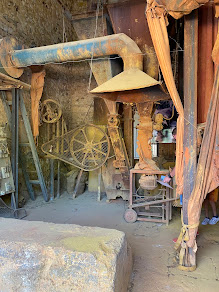


Yellow ocher grinding process

Packing
Today, between still 800 and 1,000 tons of ochre are extracted per year.
Applications:
- In the building industry : for colouring coatings, lime paints, concrete...
- In industrial or artistic paintings.
- In agriculture : for coloring fertilizers.
- For the coloring of terracotta, tiles.
- For cosmetics to colorate powders and eyeshadows.
- In the ceramic industry.

Dry Pastels Crayons production. On site you can join in small workshop, to try make your own pastels and draw with them.


EcoMuseum Roussillon
Today and before, ocher was used to paint the walls of buildings, inside and out. The best known are Lime wash and swedish paint, which differs in the preparation process and the binding ingredients.
Limewash traditionally used on walls, it is Matt and natural and allows walls to breathe,

“Swedish paint”, “ochre paint” or “wheat paint”, for a change, it is a traditional paint that was cooked with flour, water, pigments, black soap, linseed oil and iron sulphate. It protects wood sustainably for up to 10 years and naturally.
And this will be next trip about to come after summer holidays 😃 Falun! here we come!


The end of museum trip you can spend in pigment shop full of colorants and books in French only!!😂
So, how looks the place of extraction of ocher?
That is next trip!
Xoxo
Lajtkraft


Comments